Principles of visual perception by Carolyn M. Bloomer
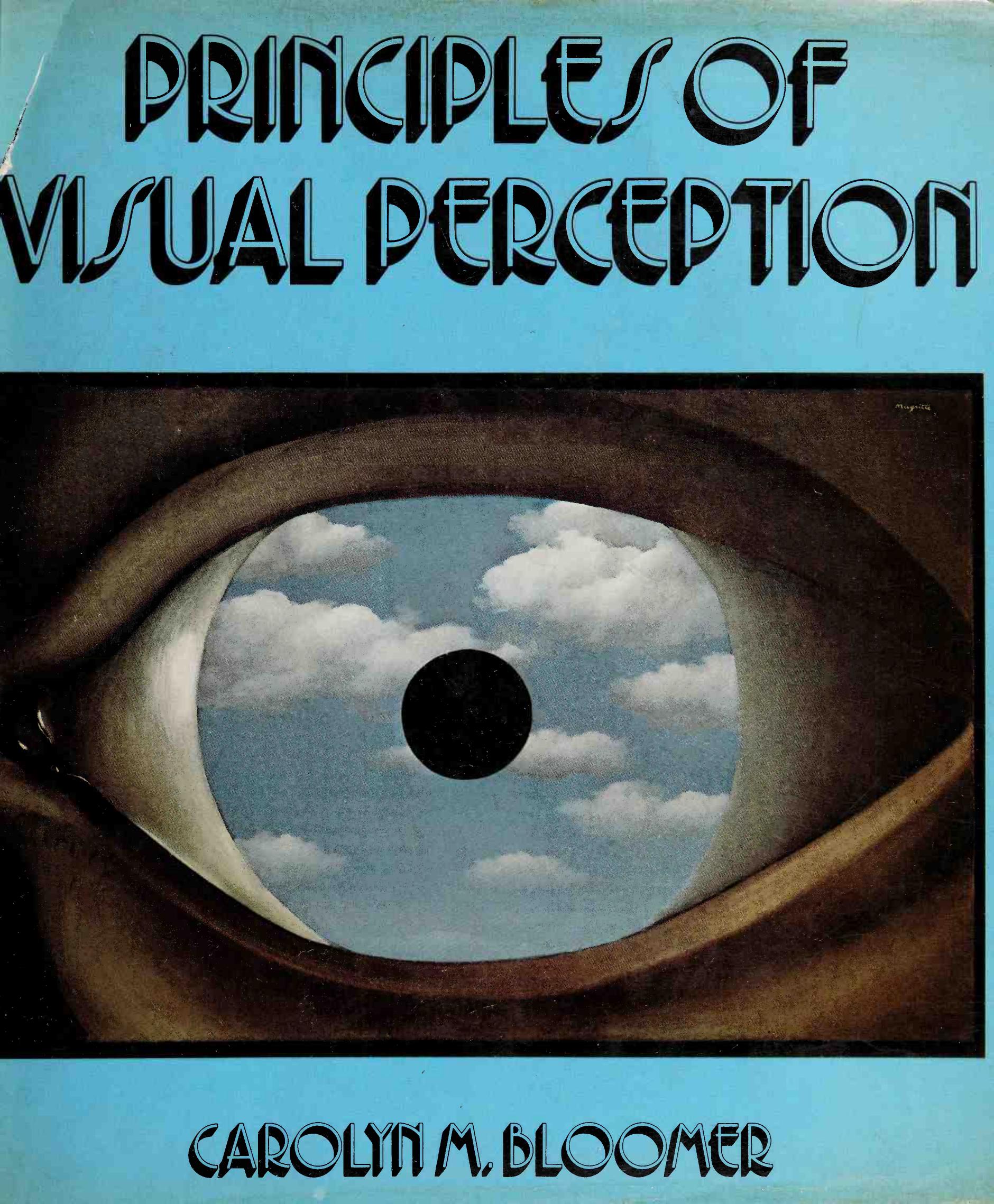
Author:Carolyn M. Bloomer
Language: eng
Format: epub, pdf
Tags: Visual perception, Composition (Art), Art -- Psychology, Visual perception, Optical illusions, Art appreciation
Publisher: Van Nostrand Reinhold Co.
Published: 1976-10-25T16:00:00+00:00
N
The Moving Picture
Is a lizard alive? Yes.
A nail? No.
A flower? No.
A tree? No.
Is the sun alive? Yes. Why? Because it moves when it has to.
Are the clouds alive? Yes, because they move and then they hit. What do they hit? They make the thunder when it rains.
Is the moon alive? Yes, because it moves.
The fire? Yes, because it crackles.
Is the wind alive? Yes, because on a windy day it’s cold, it’s always going faster.
A mountain? No, because it’s always in the same place.
A motor? Yes, because it moves.
You know what it is to be alive? Yes, to move.^
For the child motion is magical, life-giving. His world is a field of movement, activity, spontaneous forces—life. Newborn infants—even before they can focus—follow moving objects with their eyes. And they are calmed by motion when they are rocked or carried. From birth humans respond to movement.
You arrive in the world with a physiology programmed for motion. The very functions and structures of your body require motion to maintain life. Without exerciseyour health declines; your metabolism becomes sluggish. Muscles atrophy from disuse. Just sitting too long in one position
causes cramped muscles, stiff joints. Motion activates your nerve cells, gives you knowledge of yourself, tells you that you exist. Humans dread paralysis, the loss of motion, as a kind of death.
Freedom, our most cherished value, is defined in terms of motion:
. . . able to move in any direction, not held, as in chains, etc., not kept from motion, loose, not held or confined, unhindered, unhampered, not restricted by anything except its own limitations or nature..
Those who would control us—whether for good or for ill—begin by controlling our movement:
Stay real close to Mommy, now.
Sit in your seat. Raise your hand if you need to leave the room. And sit still!
Atten-hut! Forward march! Left, right, left, right... No running. No fishing. No hunting. No skating. No swimming. Do not walk on the grass.
Stop!
The language of motion expresses a variety of activities and experiences: consider such terms as emotion, 6emotion, promotion, commotion, loco-motion.
PHYSIOLOGY
The perception of motion can be most simply define.d as the perception of a succession of changes. The ability to detect motion is clearly an
Download
Principles of visual perception by Carolyn M. Bloomer.pdf
This site does not store any files on its server. We only index and link to content provided by other sites. Please contact the content providers to delete copyright contents if any and email us, we'll remove relevant links or contents immediately.
The Great Music City by Andrea Baker(33427)
Aircraft Design of WWII: A Sketchbook by Lockheed Aircraft Corporation(32380)
Call Me by Your Name by André Aciman(20703)
The Secret History by Donna Tartt(19442)
The Art of Boudoir Photography: How to Create Stunning Photographs of Women by Christa Meola(18753)
Shoot Sexy by Ryan Armbrust(17843)
Plagued by Fire by Paul Hendrickson(17527)
Portrait Mastery in Black & White: Learn the Signature Style of a Legendary Photographer by Tim Kelly(17098)
Adobe Camera Raw For Digital Photographers Only by Rob Sheppard(17076)
Photographically Speaking: A Deeper Look at Creating Stronger Images (Eva Spring's Library) by David duChemin(16794)
Ready Player One by Cline Ernest(15122)
Pimp by Iceberg Slim(14777)
Bombshells: Glamour Girls of a Lifetime by Sullivan Steve(14210)
The Goal (Off-Campus #4) by Elle Kennedy(13947)
Art Nude Photography Explained: How to Photograph and Understand Great Art Nude Images by Simon Walden(13141)
Kathy Andrews Collection by Kathy Andrews(12077)
The Priory of the Orange Tree by Samantha Shannon(9349)
The remains of the day by Kazuo Ishiguro(9202)
Thirteen Reasons Why by Jay Asher(9103)
